


The Short Answer: Reverse osmosis installation involves tapping into the cold water line, mounting a dedicated RO faucet, connecting a drain line, setting up the filter housings and storage tank, and flushing the system before the first glass. Most under-sink RO systems need cabinet space, a nearby drain, steady water pressure, and in some cases an electrical outlet. The right setup depends on what is in your water, so a water test is the best first step.
A reverse osmosis system pushes tap water through a semi-permeable RO membrane with pores of about 0.0001 micron, which reduces many dissolved contaminants that a basic pitcher or fridge filter may let through. Most residential systems treat water at a single tap, usually the kitchen sink, so purified water is ready for drinking, cooking, coffee, and ice cubes. The steps are simple on paper, but each connection sits inside a cabinet where a slow leak can go unnoticed for weeks. Knowing what each part of the job involves makes it easier to plan the project and decide who should handle it.
Planning Before the Installation
Test the Water First
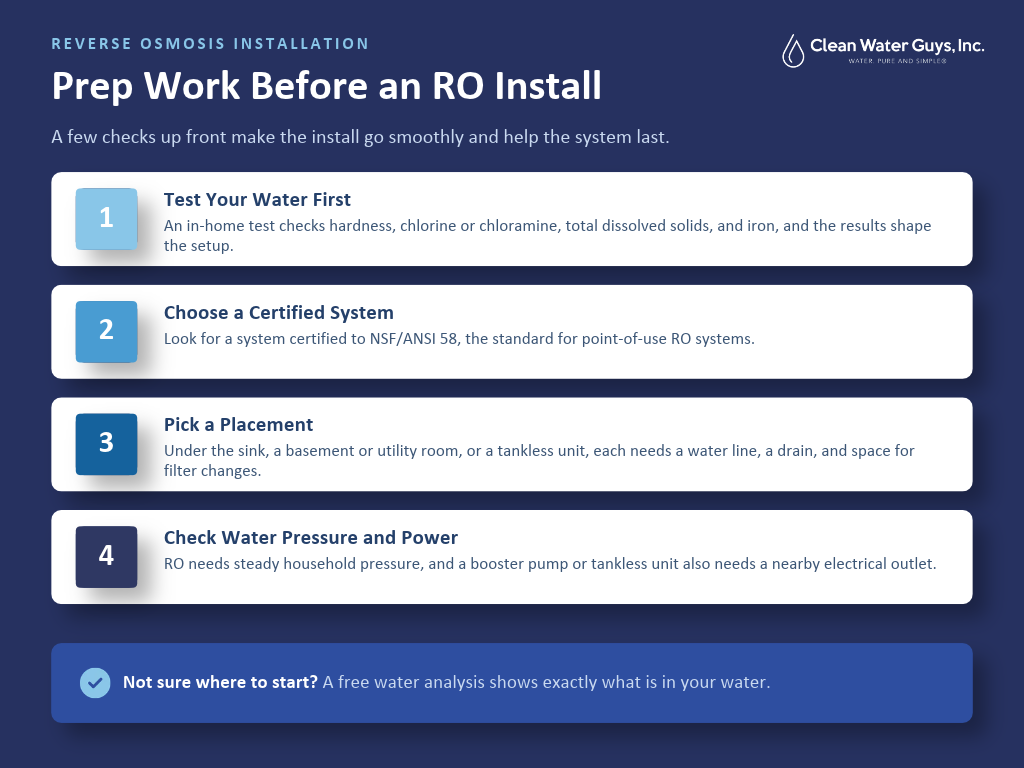
An RO system is one part of home water treatment, and the water going into it affects how long the system lasts. Homes on municipal water can review their utility’s water quality report, though that report reflects system-wide sampling rather than the water at a single faucet. An in-home test checks hardness, chlorine or chloramine, total dissolved solids, and iron. Those water conditions shape the setup.
In the Omaha area, where municipal water is hard and treated with chloramine, many homes pair RO with a softener or whole-house filter, since hardness minerals can wear on an RO membrane over time.
Choose a Certified System
When comparing options, look for a system certified to the standard for point-of-use RO systems, which covers material safety and contaminant reduction claims.
Common Placement Options
- Under the Kitchen Sink: The usual spot for an under-sink RO system. The cabinet needs room for the filter housings, storage tank, tubing, and enough clearance to reach the cartridges during filter replacement.
- Basement or Utility Room: A remote install keeps the sink cabinet clear, with a line running up to the faucet. The spot still needs access to a water line and a drain.
- Tankless RO System: A smaller footprint with no storage tank. Many tankless models use an internal pump, so they need an electrical outlet nearby.
Many systems can also send RO water to a refrigerator water dispenser or ice maker, which adds a tubing run to plan for.
Check Water Pressure and Power
RO relies on household water pressure to push water through the membrane. Low pressure can slow the flow rate and make the storage tank take longer to refill, and some homes need a booster pump to keep production steady. A booster pump or tankless unit needs an electrical outlet. Before unplugging anything under the sink, it helps to note which outlet powers the garbage disposal and which powers the dishwasher so they go back in the right place.
If you have questions about choosing a system or location for your reverse osmosis system, request a free water analysis or call Clean Water Guys to get recommendations tailored to your home.
The Installation Process Step by Step
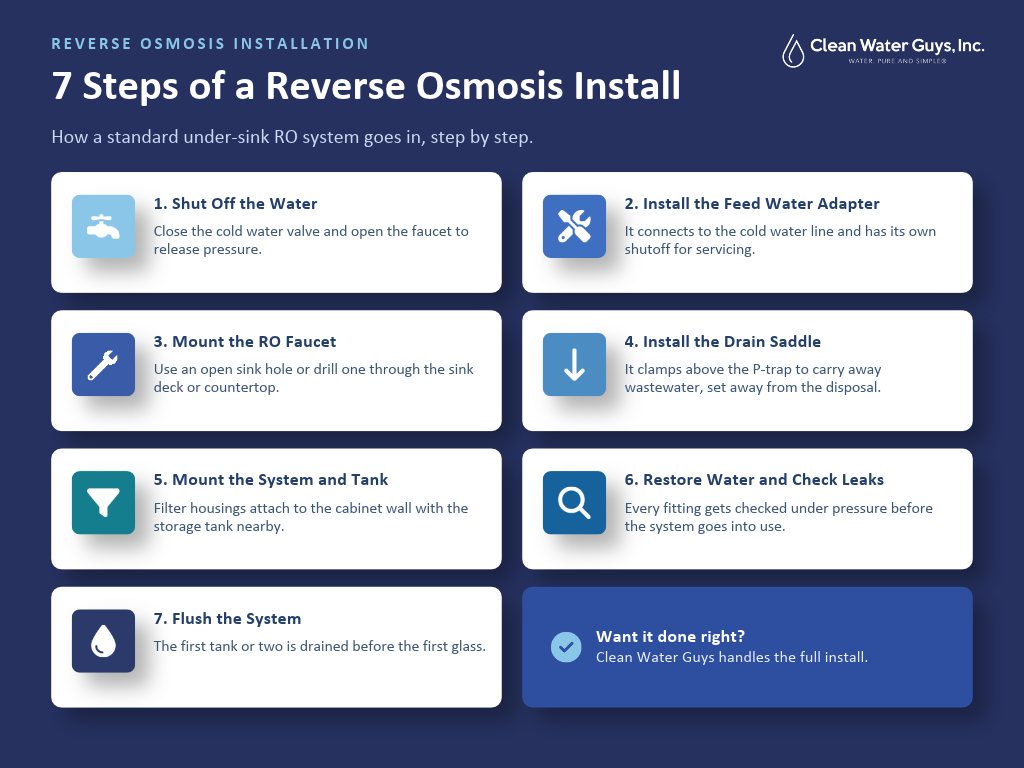
A standard reverse osmosis system installation under the sink follows a similar order across most brands:
- Shut Off the Water Supply: Close the cold water valve under the sink and open the faucet to release pressure.
- Install the Feed Water Adapter: A feed water adapter, sometimes called a feed water valve, connects to the cold water line and sends water to the RO system. It has its own shutoff, so the system can be serviced while the sink stays in use.
- Mount the RO Faucet: The faucet goes in an unused sink hole, in the opening where a soap dispenser or sprayer sat, or in a new hole drilled through the sink deck or countertop. Drilling a stone countertop takes a diamond bit and extra care, and many homeowners prefer to leave that part to an installer.
- Install the Drain Saddle: The drain saddle clamps onto the sink drain pipe above the P-trap and carries away the concentrated wastewater. Placing it away from the garbage disposal helps keep food waste out of the drain line. Some local codes call for an air gap faucet as well.
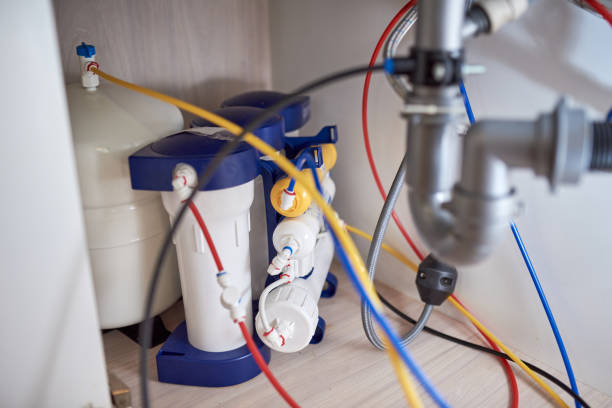
- Mount the System and Storage Tank: The filter housings attach to the cabinet wall, and the storage tank sits nearby. Color-coded tubing links the supply, tank, faucet, and drain.
- Restore Water and Check for Leaks: Each fitting gets checked once the system is pressurized. A quiet trickle at the drain line is normal while the system produces water.
- Flush the System: A new carbon filter and RO membrane need flushing before use, so the first tank or two is drained according to the manufacturer’s directions.
Once the tank fills after flushing, the system is ready to deliver clean, great-tasting water at the RO faucet.
Why Choose Professional Installation
Under-sink kits are sold for DIY installation with basic tools, but many RO problems start during the install. They often show up weeks later as a slow leak under the sink or a membrane that wears out early. A professional installation helps prevent those problems in a few ways:
- Fewer Leaks: An installer checks the feed water adapter, drain saddle, and every fitting under pressure before the system goes into use.
- Safer Drilling: Installers usually bring the right bits for a stone countertop or porcelain sink, where a mistake can crack the surface.
- A Setup Matched to Your Water: A water test shows if hard water or iron could shorten the life of the membrane. A water softener or whole-house filtration can then be sized to work with the RO system.
- Ongoing Support: Filter replacement, membrane changes, and customer support all come from the same local team.
Some warranties are also tied to professional installation, so a DIY install can limit coverage if something goes wrong.
Caring for the System After Installation
An RO system keeps producing better-tasting water as long as its parts are maintained.
Routine RO Maintenance
- Filter replacement: Sediment and carbon prefilters are changed on a set schedule, and sooner if a chlorine taste comes back.
- Membrane replacement: Manufacturers often call for a new reverse osmosis membrane every one to three years, or sooner if taste, odor, or output changes.
- Sanitizing: The housings and storage tank are sanitized during service to keep the system clean.
RO does not remove dissolved gases such as hydrogen sulfide, which causes a rotten-egg smell. Homes with that odor or with rust staining may need iron and odor treatment at the point of entry so the RO system can focus on drinking water.
Planning Your RO Installation With Clean Water Guys
Clean Water Guys is a family-owned water treatment company founded in Omaha in 1979, serving homeowners across the greater Omaha area, including nearby Nebraska and Iowa communities. The team handles complete residential water treatment, including reverse osmosis drinking water systems like the Icon Plus Reverse Osmosis Water System, water softeners, whole-house filtration, iron and odor removal, and salt-free, UV, and ozone options. Clean Water Guys is a 3M Authorized Water Dealer with WQA Certified Installers and has been voted Best of Omaha for over 10 years.
The process starts with a free water analysis. From there, homeowners can see options and pricing matched to their household needs. After the installation, ongoing service includes yearly checkups, filter replacements, and salt drop-offs for homes with a softener. Families building a new home can work with the new construction team to plan the RO line before move-in.
Book Your Free Water Analysis
Call Clean Water Guys or fill out the contact form to schedule your free water analysis. Then visit the showroom or book an in-home consultation to see which reverse osmosis system fits your kitchen and your water.
Frequently Asked Questions
Can I install a reverse osmosis system myself?
Yes, many homeowners can install a reverse osmosis system themselves, but most RO system problems come from the install. Drilling a faucet hole in stone or porcelain, setting up the drain connection, and knowing if the water needs pretreatment first all can lead to problems later. A professional installation handles the trickier parts, so problems are less likely later.
Do I need a plumber to install a reverse osmosis system?
You do not always need a plumber to install a reverse osmosis system, but local code may affect how the drain connects and if an air gap faucet is required. A certified water treatment installer can handle the plumbing and match the system to a water test.
Can a reverse osmosis system be installed without drilling holes?
A reverse osmosis system can often be installed without drilling if the sink has an unused hole or a soap dispenser or sprayer opening that the RO faucet can use. If no opening is available, a hole is drilled through the sink deck or countertop.
Can a reverse osmosis system be installed in the basement?
A reverse osmosis system can be installed in a basement or utility room, with a line running up to the kitchen faucet. The location needs access to a water supply line and a drain, and the extra tubing run may affect water pressure at the faucet.
Can a reverse osmosis system connect to my refrigerator?
Many reverse osmosis systems can connect to a refrigerator water dispenser or ice maker with an extra tubing line. The run length and water pressure should be checked first so the RO faucet and the fridge both get good flow.
Should I install reverse osmosis with a water softener?
Many homes with hard water install reverse osmosis with a water softener, since hardness minerals can wear on the RO membrane over time. A water test shows how hard the water is and if a softener makes sense.
How much does reverse osmosis installation cost?
The cost of reverse osmosis installation depends on the system type, the installation location, the need for drilling or a new electrical outlet, and any pretreatment in the plan. A free water analysis gives a clear picture of options and pricing for a specific home.