



The Short Answer: Nitrate is a dissolved compound that reaches groundwater through fertilizer, animal waste, and septic systems, and it cannot be tasted, smelled, or seen. The federal limit for drinking water is 10 mg/L measured as nitrogen. Nitrate is removed by reverse osmosis, anion exchange, or distillation. A standard water softener, a carbon pitcher filter, and boiling do not remove it. If your home draws from a private well in eastern Nebraska, an annual test is the only reliable way to know your nitrate level.
Nitrate is one of the few water quality problems that gives a homeowner no warning. Hard water spots glassware, iron stains a tub, and sulfur announces itself the moment a faucet opens. Nitrate can become an issue in this part of the country, since much of Nebraska’s groundwater sits under agricultural areas.
How Nitrates Affect Health
The federal maximum contaminant level for nitrate is 10 mg/L measured as nitrogen, and concentrations above 3 mg/L generally point to contamination rather than natural background levels. That 10 mg/L figure was set primarily to protect infants. The Metropolitan Utilities District (MUD) of Omaha reports nitrate levels of about .49 mg/L as of February 2026, and Omaha tap water is considered safe to drink. MUD regularly tests Omaha water for nitrate levels, however homes and properties on private wells will need to test on their own, since high nitrate levels in a private well can go unnoticed.
Infants and Pregnancy
In an infant’s digestive system, bacteria convert nitrate to nitrite, and nitrite interferes with the blood’s ability to carry oxygen. The result is methemoglobinemia, usually called Blue Baby Syndrome. Babies under six months are the most vulnerable group, and the risk is highest when well water is used to mix infant formula. Pregnant women are also commonly identified as a higher-risk group. Health agencies generally advise using bottled water for formula and drinking water until the well has been tested and treated.
Longer-Term Questions
Research into long-term nitrate exposure is ongoing and not settled. Some studies have reported associations between extended consumption and certain health outcomes, including at levels below 10 mg/L, though the links between concentration, volume consumed, and duration are not fully understood. Anyone with specific health concerns about their own water is better served talking with a physician than with a water treatment company.
Testing Your Water for Nitrates
Because nitrate has no taste, color, or odor, a test is the starting point for every decision that follows. Clear water that tastes fine can still be above the standard.
A few things worth knowing before you test:
- Nitrate levels change with rainfall, irrigation, and nearby field activity, so a test from several years ago is not current information.
- Annual testing is the general recommendation for private wells, and more often after an elevated result.
- Testing for bacteria at the same time is reasonable practice, since the pathways that let nitrate into a well often let other things in too.
A professional water analysis covers more ground than a single-parameter kit, looking at hardness and iron alongside nitrate. That matters because the right equipment depends on everything in the water rather than one number.
What Actually Removes Nitrates
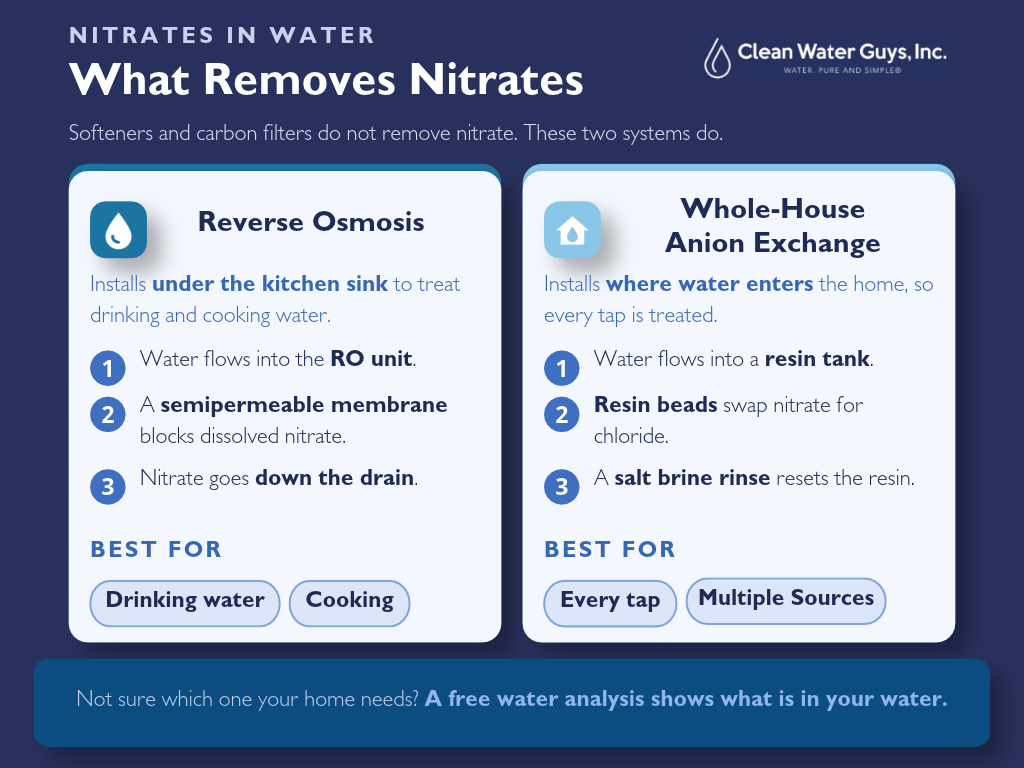
Nitrate dissolves completely in water and carries a negative charge, which rules out most of the filters people already own. Ion exchange, reverse osmosis, and distillation are the methods recognized for removing nitrate from drinking water.
Reverse Osmosis at the Tap
A reverse osmosis system pushes water through a semipermeable membrane that rejects dissolved nitrate and sends it down the drain. It installs at the point of use, typically under the kitchen sink, feeding a dedicated faucet and often the refrigerator line. For most households dealing with nitrate, point-of-use RO is the practical answer, since drinking and cooking water is where the exposure happens. Our Icon Plus reverse osmosis system fills that role in Omaha-area homes.
Whole-House Anion Exchange
Anion exchange treats the whole house by swapping nitrate ions for chloride on a nitrate-selective resin. It works on the same general principle as a softener and regenerates in a similar way, but the resin is a different type chosen specifically for nitrate. This approach suits a household that wants every tap treated, and it generally carries higher operating cost than point-of-use RO.
What Does Not Work
Several popular assumptions fall apart with nitrate:
- A standard water softener removes calcium and magnesium through cation exchange and is not designed to capture nitrate.
- Carbon pitcher and refrigerator filters do not remove nitrate.
- Boiling does not reduce nitrate and actually concentrates it as water evaporates.
- Sediment filters catch particles, not dissolved ions.
Where Nitrates Come From
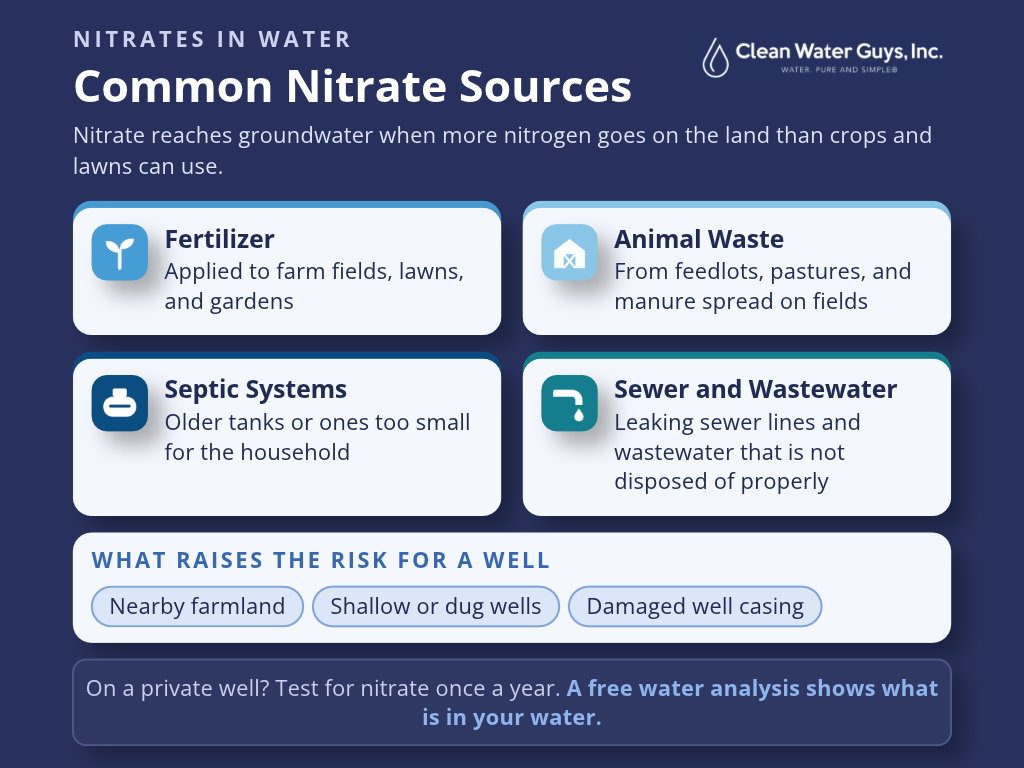
Nitrogen is part of every living thing, and nitrate is the form plants take it up in. Trouble starts when more nitrogen is applied to the land than crops and lawns can use. Rain and irrigation carry the surplus down through the soil and into the aquifer below.
Common Sources of Nitrate
- Commercial fertilizer applied to farm fields, lawns, and gardens
- Animal waste from feedlots, pastures, and manure applications
- Septic systems, particularly older tanks or ones undersized for the household
- Leaking sewer lines and improperly disposed wastewater
Two factors tend to raise the risk for an individual home. The first is proximity to agricultural land. The second is the well itself, since shallow wells, dug wells, and wells with damaged casing give surface water a quicker path to the water you drink. Nitrate is present in groundwater throughout much of Nebraska, and concentrations are rising in some areas.
If your home is on Omaha’s public water system, the utility tests on a regulated schedule and has to notify customers when nitrate exceeds the standard. Private wells carry no such requirement, which is the heart of the problem. State data suggests roughly 17% of Nebraska’s private domestic wells exceed the drinking water standard, while fewer than 10% of those wells are sampled for nitrate in a given year.
Where Softening and Filtration Fit In
None of this makes softening and filtration beside the point. Most Omaha-area homes have more than one water issue, nitrates often sit alongside hardness, chlorine taste, iron staining, or an odor problem.
A water conditioning system addresses hardness, which is what drives scale in water heaters and spotting on dishes. A whole-house filtration system works at the point of entry on sediment and chlorine taste and odor. Those systems also protect an RO unit, since cleaner, softened feed water extends membrane life. The common setup for a home with high nitrate levels is softening and filtration handling the whole house, with RO handling what the family drinks, which is how our home solutions are usually designed.
How to Decide What Your Home Needs
The decision usually comes down to a few questions. Is nitrate above the standard or well under it? Is there an infant or an expecting mother in the house? Do you want treated water at one tap or at all of them? What else did a water analysis find?
Those cannot be answered from the outside, and a company will test your water before quoting your equipment. A water analysis turns general advice into a specific recommendation for your address and your household.
What Working With Clean Water Guys Looks Like
Clean Water Guys is a family-owned water treatment company serving homeowners across the greater Omaha metro, and a 3M authorized dealer. We have been voted #1 in Water Treatment Systems in Best of Omaha, with more than 10 Best of Omaha wins overall.
The process starts with a free water analysis. We test your water, walk you through what the results mean, and lay out the options that fit. You can visit the showroom to see systems in person or have us come to the house. We give you options and pricing without a hard sell, and after installation, we stay involved with yearly checkups, filter replacements, and salt drop-offs.
Get Your Water Tested and Pick the Right System
Find out what is actually in your water before spending anything on equipment. Schedule your free water analysis or call Clean Water Guys, then visit the showroom or book an in-home consultation to see which softener, filtration, or reverse osmosis system fits your home.
Frequently Asked Questions
Is it safe to shower or bathe in water with high nitrate?
Showering and bathing in water above the nitrate standard is generally considered safe, because nitrate does not readily pass through the skin, as long as the water is not swallowed. Supervision matters with young children who might drink bath water.
Does boiling water remove nitrates?
Boiling water does not remove nitrates. Boiling evaporates some of the water while the nitrate stays behind, which raises the concentration rather than lowering it.
Do water softeners remove nitrates?
A standard water softener does not remove nitrates. Softeners use cation exchange to take out calcium and magnesium, and nitrate is a negatively charged ion that passes straight through. Removing it takes reverse osmosis, a nitrate-selective anion exchange system, or distillation.
What is a safe nitrate level in drinking water?
The federal limit for nitrate in drinking water is 10 mg/L measured as nitrogen. Readings above 3 mg/L typically indicate contamination from human activity, and some clinicians recommend a lower target for infants. State data suggests roughly 17% of Nebraska private wells exceed the limit.
How often should I test my well water for nitrates?
Private well owners should test for nitrates once a year, and more often after an elevated result or if the well is shallow or near farm fields. Public water customers can get nitrate results from their utility instead.
Does reverse osmosis remove nitrates from drinking water?
Reverse osmosis does remove nitrates from drinking water. The membrane rejects dissolved nitrate and flushes it to the drain, and systems certified for nitrate and nitrite reduction under NSF/ANSI 58 have been tested for that specific claim.