


The Short Answer: Most restaurants need more than one kind of treatment, matched to the equipment behind each water line. Carbon filtration handles chlorine taste at the coffee brewer, ice maker, and fountain. Omaha water runs about 10 grains per gallon, hard enough to scale anything that heats or freezes it. Scale control, either a scale inhibitor cartridge or a water softener, protects anything that heats or freezes water. Reverse osmosis goes in where taste and clarity matter most. A water test tells you which combination your building calls for.
Restaurant water filtration gets treated as one purchase, and that is where most operators go wrong. The espresso machine, the ice maker, the dish machine, and the combi oven all draw the same municipal water, but each fails in its own way. One scales up. One picks up a chlorine taste. One leaves film on glassware. A single cartridge sized for the whole building usually solves one of those and leaves the rest alone.
What Water Does to a Commercial Kitchen
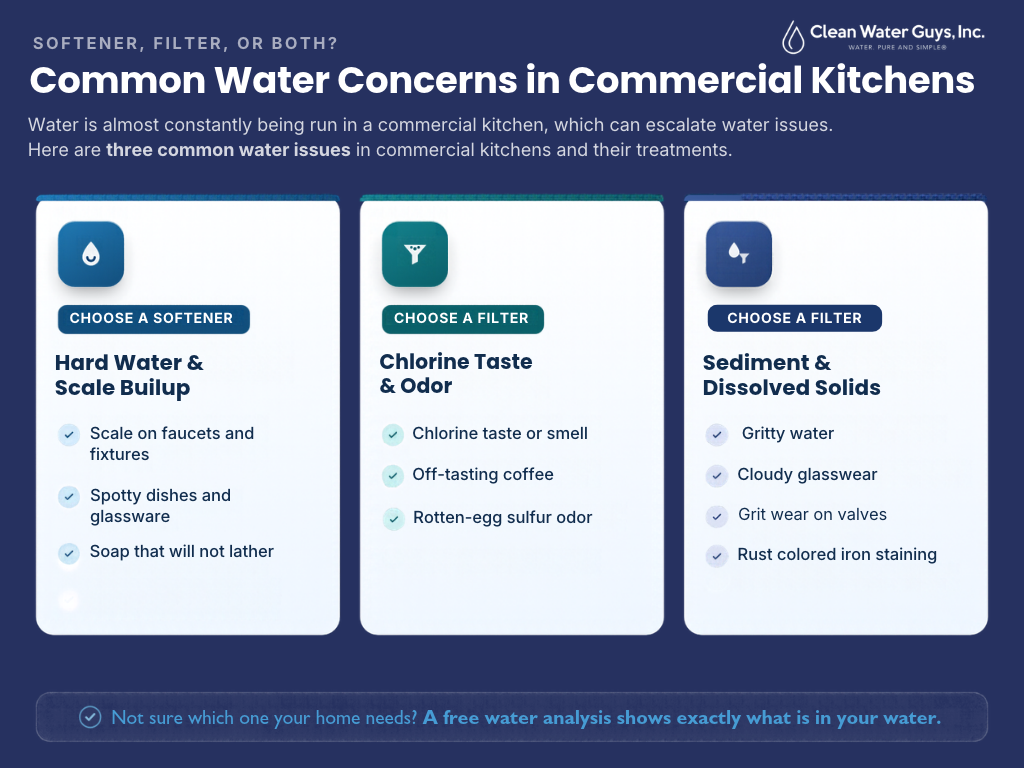
In a commercial kitchen, where water is used almost constantly, hard water can lead to additional wear and tear on your equipment, shortening lifespans and raising costs. Proper water filtration can keep a kitchen running smoothly, but water quality conditions need to be identified. Three conditions are behind most of the complaints that come out of a food service operation.
Hardness and Scale Buildup
Hard water carries dissolved calcium and magnesium ions. When that water is heated or frozen, the minerals can come out of solution as solid calcium carbonate deposits. In a kitchen, this shows up as mineral deposits on ice machine evaporator plates and crusted heating elements in coffee machines. You also may notice booster heaters and steam equipment need delimbing more often than the manual suggests. Scale deposits are a standard indicator of hard water, and usually the first sign an operator notices.
Omaha metro operators are working with meaningful mineral content. Municipal water here is lime-softened to roughly 170 milligrams per liter, about 10 grains per gallon of hardness, which lands in the hard range on the standard scale. This means the water is drinkable but leaves scale on equipment using lots of water, like faucets, dishwashers and coffee machines.
Chlorine Taste and Odor
Municipal systems disinfect, and the residual is what your customers taste in a glass of water, a soda, or a cup of coffee. Taste and odor problems fall under non-health guidelines that exist because these conditions make otherwise safe water unpleasant. A chlorine note carries straight through to the finished drink, so beverage quality is where it costs you.
Sediment and Dissolved Solids
Particulates, rust, and grit wear on valves, seals, and pumps and can clog spray nozzles. High dissolved solids tend to show up as cloudy ice and spotting on glassware. Implementing a sediment stage into your water filtration system solves these problems.
Systems Tailored to Your Food Service Operation

Each restaurant and food service business will have different systems needs, depending on water quality levels and water usage. Food service equipment manufacturers specify their own water requirements, and those specs are the place to start. Past that, the right setup follows the type of operation, because each one runs its volume through different equipment. For a more detailed examination of your water quality, schedule a free water analysis.
Coffee Shops and Cafes
A coffee shop is the one case where more filtration is not the goal. Coffee brewers, coffee makers, and espresso machines need chlorine and sediment filtered out so the drink tastes right. However, you can strip the water too far as coffee needs some mineral content to taste full. The usual answer is carbon filtration with scale control on the brew line and at the espresso machine. Reverse osmosis can be added where the water is blended back up to a target mineral content.
Quick Service and Fast Casual
Most of the water volume here runs through cold drinks, so the ice machine and the beverage dispensers are the main focus. An ice machine freezes most of the water it takes in, which can leave concentrated minerals behind. The concentrated minerals leave scale on the evaporator plate and create cloudy ice in the bin. The common build gives each machine its own filter cartridge containing:
- Sediment Filtration: For grit and particles
- Carbon Filtration: For chlorine taste and odor, with a fine micron rating to catch the particulates that cause haze
- A Scale Inhibitor: Keeps minerals from hardening into scale
Beverage equipment is taste-first, so reverse osmosis is a step up when an operator wants the same drink every time despite seasonal shifts in the incoming water quality.
Full-Service and Banquet Kitchens
With a busy dish line and glassware going out to tables, the problem is hardness rather than contaminants. A point-of-entry water softener is often the best fit as it treats water hardness rather than taste. Soft water cuts spotting and film, keeps scale off the booster heater, and generally lets detergent work at a lower dose, worth a conversation with your chemical supplier once soft water is in.
Bakeries and Steam Kitchens
Steam equipment concentrates minerals the same way an ice maker does, with heat instead of cold. Combi ovens, steamers, and proofers respond to scale control upstream. Softened water cuts how often the equipment has to be delimed.
How the Main Systems Differ
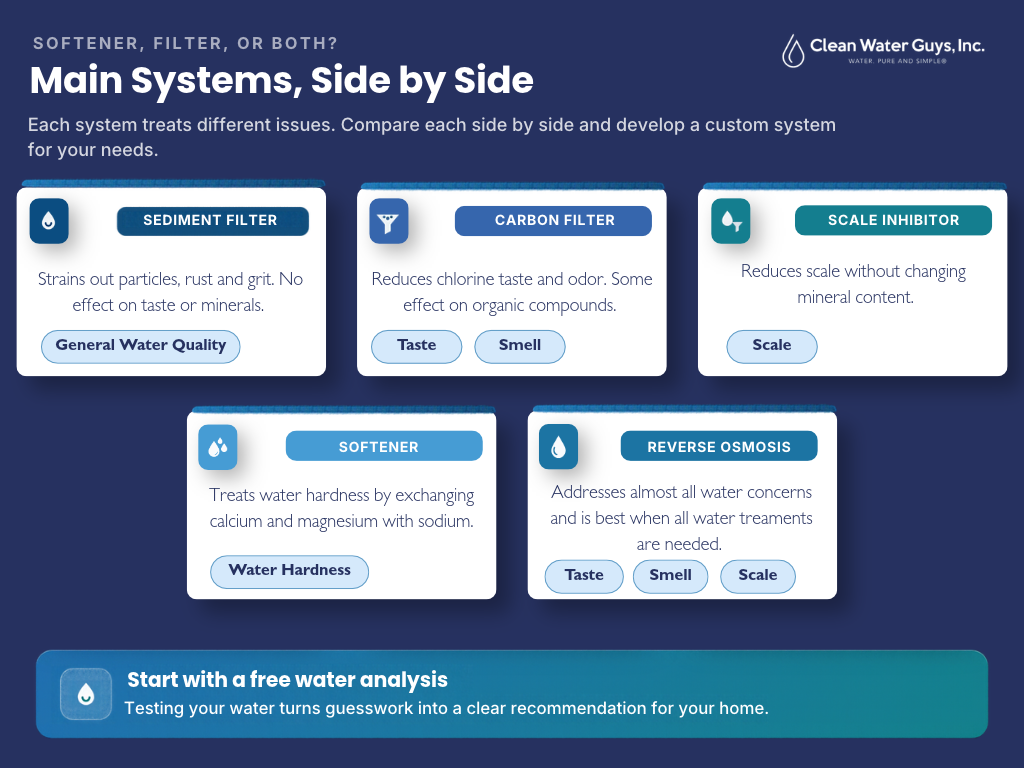
A softener and a water filter are not interchangeable. A softener addresses the hardness that drives scale buildup. A filter addresses what you can taste and see. Plenty of kitchens need both, with softeners addressing wear on parts and filtration or reverse osmosis handling the beverage stations.
- Sediment Filtration: Strains out particles, rust, and grit. First stage at nearly every station. No effect on taste or dissolved minerals.
- Carbon Filtration: Reduces chlorine taste and odor and some organic compounds. A common choice for coffee, ice, and fountain lines. Does not remove hardness.
- Scale Inhibitor Cartridges: Feed a small amount of food-grade polyphosphate that keeps hardness minerals from adhering as scale. Protects equipment without changing mineral content. Often paired with sediment and carbon in one cartridge.
- Water Softener: Uses ion exchange to swap calcium and magnesium for sodium, then regenerates with salt on a cycle. Treats hardness at the point of entry, which makes it the usual answer for dish lines, booster heaters, and steam equipment across a whole building.
- Reverse Osmosis: Pushes water through a semi-permeable membrane under pressure, with sediment and carbon stages ahead of it to protect the membrane. Produces purified water low in dissolved solids, with fewer heavy metals and other harmful contaminants than untreated tap water.
Clean Water Guys sizes and installs reverse osmosis water purification for restaurants and cafes where taste, clarity, and equipment protection all matter at once.
Sizing, Cartridges, and Maintenance
Three numbers decide what a filtration system can do in service.
- Flow Rate: The system has to keep up with peak demand without dropping water pressure at the equipment. Undersizing shows up during a rush, not during the install.
- Gallon Capacity: Rated capacity determines how long a replacement cartridge lasts before performance falls off. Capacity varies with incoming water condition, so the rating is a starting estimate rather than a fixed schedule.
- Micron Rating: Finer is not automatically better. Beverage and ice lines typically call for a fine rating, while a sediment pre-filter runs coarser so it does not clog in weeks.
Maintenance is the part that gets deferred. Cartridge changes on schedule, periodic membrane replacement on reverse osmosis systems, and routine service keep a system performing to spec. Health inspectors also generally expect records for water treatment devices, and the FDA Food Code sets expectations around ice made from drinking water and backflow protection at points of use. A serviced local install tracks change intervals, matches the replacement filter to the housing, and catches a failing membrane before it affects what you serve.
How to Decide What Your Operation Needs
Nobody can size a restaurant’s water filtration system from the outside. Two restaurants on the same block can need different setups depending on equipment mix, volume, and menu. It takes a test of the water coming into your building and a look at what each line feeds. A free water analysis establishes hardness, chlorine, and dissolved solids at your address, and the equipment list determines the rest. A coffee-forward concept with a high-volume ice maker lands in a different place than a bakery running steam equipment, and a multi-unit operator may need commercial and industrial water conditioning at higher flow rates than a single storefront. Product information sheets for food service systems let you compare specs first.
Schedule Your Free Water Analysis
Get your water tested before you buy equipment. Call Clean Water Guys at 402-330-6440 or request your free water analysis, and ask about reverse osmosis systems, commercial filtration, and softening for your kitchen. After your water analysis, we will look at your ice machine, beverage lines, and dish line together, then quote the system that fits. Check the areas we serve to confirm your location.
Frequently Asked Questions
Does a restaurant need a water filtration system?
A restaurant needs water filtration if any equipment heats, freezes, or serves water, which covers nearly every operation.
Can one filtration system handle the whole restaurant?
One type of filtration system rarely handles a whole restaurant well, because the ice, coffee, beverage, and dish lines each need something different.
What kind of water filter does a commercial ice machine need?
A commercial ice machine generally needs one cartridge that combines sediment filtration, carbon for chlorine taste and odor, and a scale inhibitor.
How often do restaurant water filter cartridges need to be replaced?
Restaurant water filter cartridges are replaced based on the cartridge’s rated gallon capacity and how hard and dirty your incoming water is, so the interval is set by a test rather than a calendar.