


At a glance: Omaha tap water is treated by the Metropolitan Utilities District and meets or exceeds every federal and state safety standard, so it is safe to drink. It is also hard and disinfected with chloramine, which is why many homeowners add filtration or softening to cut scale, improve taste, and polish their drinking water.
Turn on any tap in the Omaha metro and the water has already passed through one of the most heavily tested systems in the state. It is clean enough to meet federal rules, yet plenty of homeowners still notice spots on their glasses or a faint chemical smell. Both things are true at once, and understanding why starts with knowing where local water comes from.
Where Omaha’s Tap Water Comes From
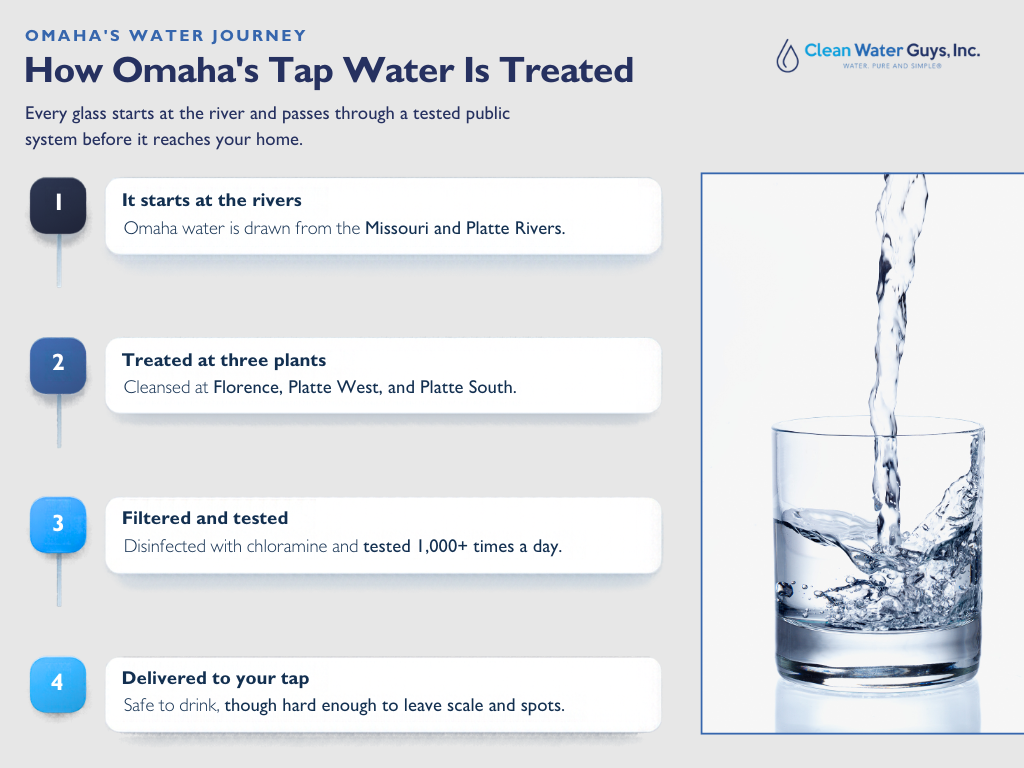
Most homes across the metro get their water from the Metropolitan Utilities District, known locally as M.U.D. The utility pulls from two main sources, the Missouri River and the Platte River, then treats that water at three plants: Florence, Platte West, and Platte South. The Platte West and Platte South sites draw river-influenced groundwater through wellfields, while the historic Florence plant treats surface water from the Missouri.
Before any of it reaches your house, the water passes through multiple treatment steps, including filtration and disinfection, and gets sampled more than a thousand times a day. That volume of testing, under both state and federal oversight, is why the tap water supply can be called safe with confidence.
Is Omaha Tap Water Safe to Drink?
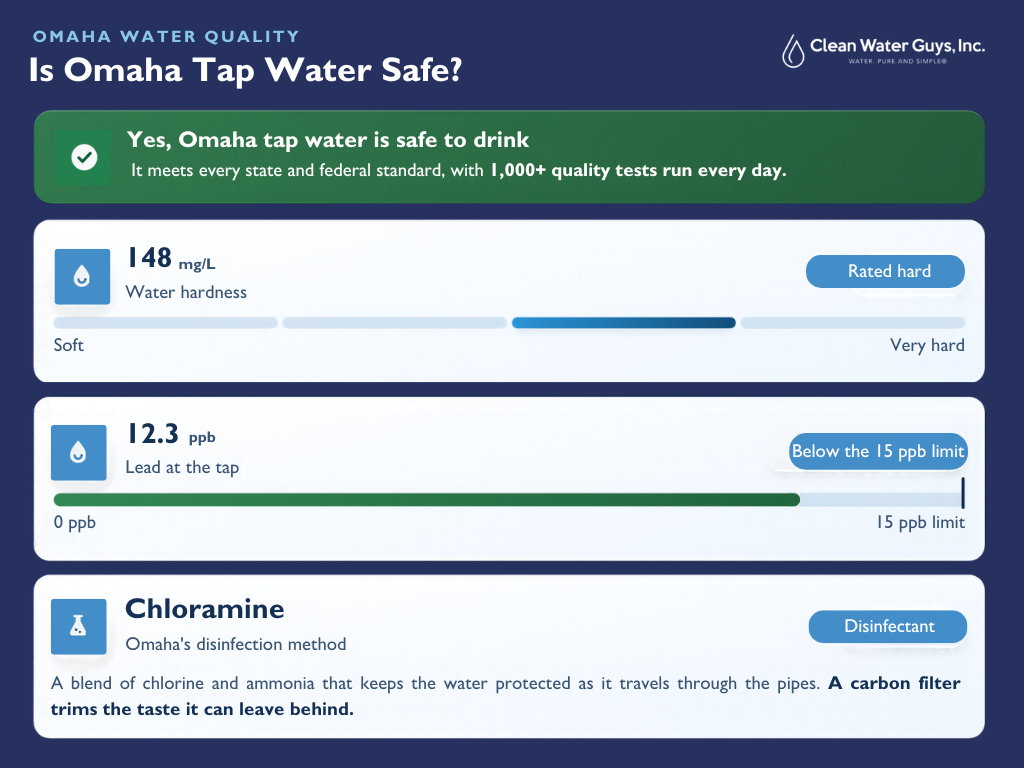
Yes. By the measures that matter for health, Omaha water quality is solid. The utility reports that the water meets or exceeds all state and federal standards for drinking water, and it is regulated by both the Nebraska Department of Environment and Energy and the U.S. Environmental Protection Agency.
Omaha disinfects with chloramine, a blend of chlorine and ammonia that keeps the water protected from bacteria as it travels through miles of pipe. Chloramine works well, but it can leave a mild taste or smell that some people notice at the kitchen tap.
Safe does not mean the water is free of everything, however. The annual report shows trace amounts of regulated substances that all fall under their legal limits, and that gap between “within limits” and “what you want in your glass” is where home filtration earns its place.
Omaha Has Hard Water
The single most noticeable trait of local water is hardness. A recent utility analysis put Omaha water at 148 milligrams per liter of total hardness, measured as calcium carbonate, which works out to roughly 8.7 grains per gallon. On the standard scale, anything between 121 and 180 is classified as hard water, so Omaha sits squarely in that range.
Hardness is not a health risk, but it is the reason behind a long list of daily annoyances:
- Scale builds up inside water heaters, dishwashers, washing machines, and pipes, which shortens the life of those appliances.
- Dishes and glassware come out of the wash spotted and cloudy.
- Soap and shampoo refuse to lather, leaving skin dry and hair dull.
- White, crusty limescale collects around faucets, showerheads, and other plumbing fixtures.
A water softener is built to remove that hardness through ion exchange, trading the calcium and magnesium for sodium so the soft water flowing to every tap is gentler on your home and your skin.
What Else is in Omaha Tap Water
Beyond hardness, a few other items show up in the local supply. None of them crossed a legal limit in the most recent reports, but each one explains why a homeowner might want treatment.
- Chloramine disinfection can carry a chlorine-like taste or smell that a carbon filter reduces, along with other organic compounds.
- Lead is not present in the source or treated water, though the 90th-percentile reading at customer taps reached 12.3 parts per billion, below the 15 ppb action level. Lead at the tap generally comes from older household plumbing rather than the utility, which is why homes built before the 1990s sometimes add point-of-use filtration.
- Low levels of heavy metals like arsenic, along with disinfection byproducts, were detected and stayed under their federal limits.
- Dissolved solids measured around 433 milligrams per liter, which contributes to taste and to the mineral film hard water leaves behind.
For most households these numbers are reassuring rather than alarming. Still, the aesthetic issues of hardness, staining, and taste are exactly the problems a treatment system is designed to solve, and they are the reason bottled water sales stay strong in a city with safe tap water.
How Filtration and Softening Help
The right fix depends on the water problems you are dealing with. A professional setup can combine a few approaches to cover the whole house and the drinking tap.
- A water softener handles hardness, stopping scale and giving you softer water for bathing, cleaning, and laundry.
- A whole-house water filtration system treats water at the point where it enters the home, so the entire home gets filtered water with less chlorine taste, sediment, and odor at every tap.
- A reverse osmosis system at the kitchen sink produces pure, great-tasting water by reducing dissolved solids and trace contaminants, which many families prefer over buying bottled water.
- Iron and odor removal units target the rust staining and sulfur smell that well owners outside the city limits often deal with.
You can explore these options on the home water treatment page, and the local water facts page breaks down what each contaminant means for your household. A professional water filtration installation matched to your specific needs will outperform a big-box softener or a store-bought water filter, because the equipment gets sized to the hardness and the contaminants in your supply.
Test Your Own Water Before You Buy
City averages are a starting point, not the final word. Your home’s water can differ based on your plumbing age, your spot in the metro area, and whether a private well or the city is your water source. A homeowner in a 1960s house with original pipes has a different situation than a new build in a west Omaha subdivision.
That is why a water analysis matters. Testing measures your hardness, checks for iron and other issues, and turns a guess into a clear recommendation. It points you to the right setup, a softener, a filter, a drinking water system, or a combination, and it keeps you from paying for equipment your water does not call for.
Cleaner Water for Your Omaha Home
Omaha tap water clears every federal and state safety standard, so it is safe to drink straight from the tap. What it is not is problem-free. The supply is hard at roughly 148 milligrams per liter, it is disinfected with chloramine that can leave a mild taste or smell, and it carries trace items that stay within legal limits. None of that makes the water unsafe, but it is why scale, spotting, and off taste turn up at home, and it is where the right softening or filtration setup earns its keep.
Clean Water Guys is a family-owned company serving homeowners across the greater Omaha metro, including Council Bluffs and the surrounding area within about a 50-mile radius. As a 3M authorized dealer with WQA certified installers and more than ten Best of Omaha wins, the team handles water softeners, whole-house filtration, and reverse osmosis drinking water, and offers ongoing support that includes responsive customer service, yearly checkups, and salt drop-offs. For families building a new house, the team works directly with homebuilders to design the system during construction.
The best way to know what your home needs is to test what comes out of your tap. Schedule a free water analysis by calling or filling out the online form, then visit the Omaha showroom or book an in-home consultation to see your options and pricing with no pressure.
Frequently Asked Questions
Is Omaha tap water safe to drink? Yes. The Metropolitan Utilities District reports that Omaha water meets or exceeds all state and federal drinking water standards, and the supply is tested more than a thousand times a day. Many homeowners still filter their water to improve taste and reduce hardness.
s Omaha water hard or soft? Omaha has hard water. Across its 2025 water quality reports, the utility averaged hardness at about 148 milligrams per liter, roughly 8.7 grains per gallon, which lands in the hard range. That hardness causes scale, spotting, and dry skin.
Does Omaha use chlorine or chloramine? Omaha disinfects its water with chloramine, a combination of chlorine and ammonia that keeps the water protected as it travels through the distribution system. A carbon filter reduces the taste and smell that chloramine can leave behind.
Is there lead in Omaha drinking water? Lead is not found in the source or treated water. Trace lead can appear at the tap from older household plumbing, and the most recent 90th-percentile reading stayed below the federal action level. Homes with older pipes sometimes add point-of-use filtration for peace of mind.
Do I need a water softener in Omaha? Most Omaha homes benefit from one because the water is hard enough to cause scale and spotting. A free water analysis measures your exact hardness and tells you whether a softener, a filter, or both is the right call for your home.